

Preparing to sell requires the same diligence and responsibility as managing a client’s financial future. In the financial industry, the calendar year often drives planning, but succession, continuity and growth should align with a long-term strategic vision. Successful advisors don’t set retirement goals or strategic plans and just forget them. They plan, review, and adjust to provide clarity and peace of mind for their families, employees and clients and preparing for succession or acquisition is as critical as managing client portfolios. Use this effective succession planning framework for your financial planning practice to potentially help you:
- Start a team discussion
- Consult with a strategic partner
- Increase your business valuation
- Create a smoother transition
- Increase the likelihood of a sale
WHERE TO BEGIN WITH SUCCESSION PLANNING
A succession plan that aims to sell your financial services business requires careful planning, execution, and adjustments as circumstances change. If you’re planning a succession or considering an offer to buy your business, think about the things you would look for as a buyer and ask yourself the key question:
Would I sell my practice to myself?
No: If your answer is “No.” or “Yes, if I did X, Y, and Z,” you know you have some work to do.
Yes: If your answer is yes, ensure you ask yourself, “Would my practice be ready to transfer all of the responsibility?” Key considerations include:
- Staffing
- Experience
- Technology, and
- Smooth Client Transitions
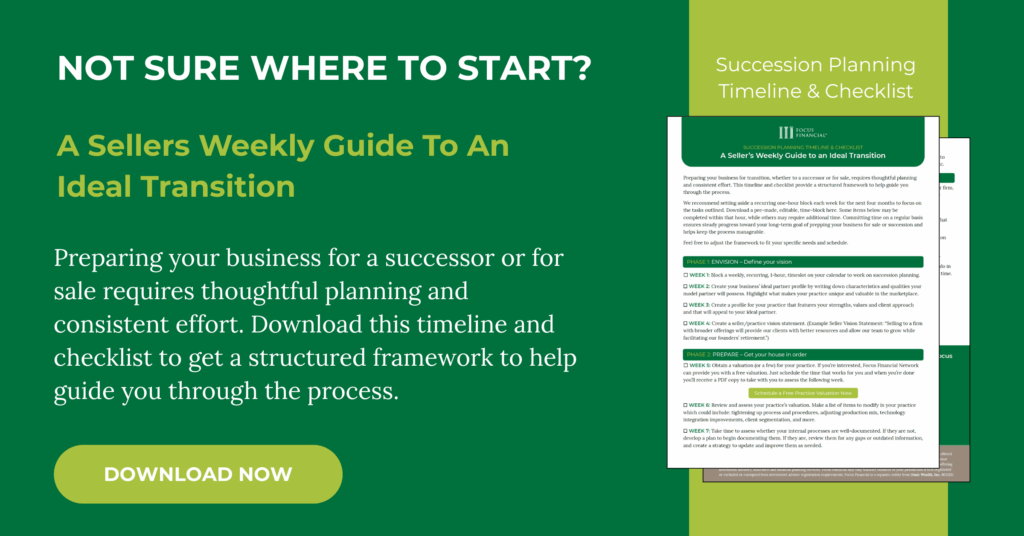
No matter your answer, start by jotting down anything you felt might need some work. Next, use this three-step framework* for sellers to help you approach succession planning effectively.
- Envision
- Prepare
- Connect & Communicate
PHASE 1: ENVISION – Define Your Succession Plan Vision
To ensure your succession activity aligns with your values and goals, use this step as your guiding light to keep your team focused when deciding how to allocate resources or walk away from opportunities that don’t fit.
- Develop your ideal partner profile: Identify the qualities you seek in a buyer.
- Create a “practice profile” to showcase your strengths, values, and client approach. Highlight what makes your practice unique and valuable in the marketplace.
- Create a seller/practice vision statement. Write one sentence that conveys the best outcome for clients, staff, and yourself when choosing a buyer. (Example: Selling to a firm with broader offerings will provide our clients with better resources and allow our team to grow while facilitating our founders’ retirement.)
PHASE 2: PREPARE– Get Your House in Order
Spend time evaluating your practice’s readiness, including:
- Obtain a Practice Valuation: Many business owners have a number in mind when it comes to what they believe their business is worth. Obtaining a formal valuation provides a helpful snapshot in time, offering clarity on how closely that estimate aligns with the business’s actual value. Consider engaging a third-party provider to assess the value of your practice. Some valuation services are offered at no cost, while others may involve a fee, depending on the provider and level of detail required. If you’re interested, Focus Financial Network can provide you with one for free. Just schedule your valuation and you’ll receive a PDF copy to take with you to assess (in number two below).
- Assess Your Practice’s Valuation: Depending on the outcome of your valuation, your takeaways could include some work like tightening up process and procedures, adjusting production mix (fee-based advisory), technology integration improvements, client segmentation and service matrix implementation, staff and talent plan documentation, and more.
- Determine if you have internal processes documented. If not, add it to your to-do list. If you do have processes documented and there are gaps, note those gaps to button them up. Internal process documentation can help determine the fit of a practice for a buyer and helps the integration process go more smoothly.
- Determine if there are ways to automate some of your business?
-
- Do you have model portfolios? Can portfolio management and servicing easier be transitioned to a new advisor/team?
- Do you have automated campaigns and consistent communication with clients?
- Do your technologies, processes, and client profiles align with prospective buyers?
PHASE 3: CONNECT & COMMUNICATE
Clear communication with both potential buyers and your current team is essential for building strong connections and ensuring alignment.
Ways to Connect:
- Are there younger advisors at your firm or in your local area that you have a relationship with or can be referred to?
- Are you active in industry associations where you may network with potential acquirers.
- Do you have relationships with strategic partners and wholesalers who interact daily with potential acquirers?
Communication Strategies
- Establish regular touch points communication to create meaningful connections with potential buyers.
- Prepare your staff for succession/transition through surveys or interviews to answer questions like:
- How long would they like to stay on after you leave?
- What complimentary skills/talents do they have to transition to a new team?
- Is your client service model replicable for a new advisor
- Create a transition plan that meets your ideal scenario, including:
- A Communication plan to clients and staff
- A timeline of how long you’d like to continue to work after the transition is executed
- A plan or at least an idea of what being, “done, done” looks like to you
- Have you discussed your retirement/succession plan with your spouse, significant other, family and strategic partners? Do you feel comfortable with the next stage in life? This is often psychological and emotional, and many put off a transition/succession due to not being ready or being uncertain for the next phase of life. Have conversations that help you prepare with your spouse, or anyone affected by your retirement. Feel comfortable with advocating and giving your last advice to clients to transition to an advisor/team that you have chosen for them.
TAKE ACTION
Your focus has been on building a thriving practice, and now that includes planning to transition it smoothly when the time comes. Whether you’re looking to create a succession plan, or explore options to merge or sell, you deserve the flexibility to take the next step on your terms. This succession planning framework can help. Structure your business in a way that aligns with your long-term goals, while accessing a partner who can provide the guidance you need to move forward with confidence.
Focus Financial Network is your go-to strategic partner that understands the value of a well-planned, well-executed transition and supports both internal and external continuity and succession. With over 25 years of experience and more than 50 successful practice transitions behind us, you gain access to deep expertise in successful succession and continuity planning.
*Source:
8631148